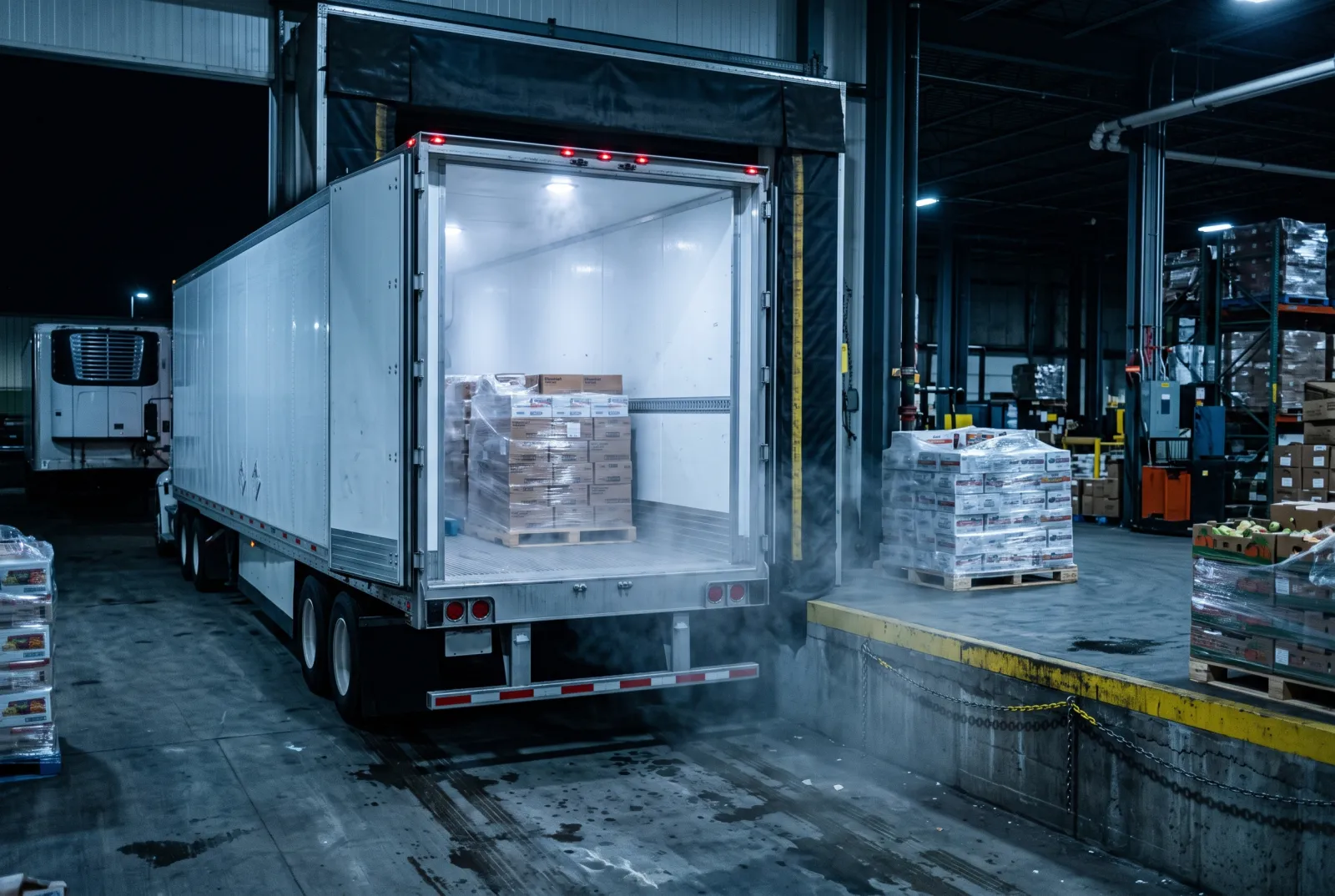
Temperature-Controlled Freight Across North America
How to ship temperature-controlled freight across Canada, the U.S. and Mexico: what each commodity needs, where produce comes from and when, and the paperwork that moves meat, seafood and other regulated food across the border.
Published October 5, 2026 · Updated October 7, 2026 · Stryke Logistics
1Reefer basics: set-point, mode, pre-cool and airflow
A refrigerated trailer does not cool freight; it holds freight at the temperature it was loaded at. The unit is built to remove the heat coming in through the walls and doors, not the heat inside the product, so product loaded warm stays warm for a long time. Almost every temperature claim starts with what happened before the doors closed.
Set-point: the temperature the unit holds. It belongs on the tender and the bill of lading in writing, with the unit of measure stated. A missing or ambiguous set-point is the most common avoidable failure.
Mode: continuous runs the fan all the time and keeps temperature even through the load; cycle, or start-stop, shuts the unit off once the set-point is reached and saves fuel. Fresh produce, chilled meat and anything sensitive to temperature swings generally wants continuous. Hard-frozen product can often run on cycle.
Pre-cool: the trailer should be at set-point before loading, with the doors closed, and the product should already be at its required temperature. A trailer cannot fix product that left the cooler warm.
Airflow: cold air leaves the unit at the front, runs along the ceiling and returns along the floor. Leave space above the load, keep pallets off the rear doors, do not block the floor channels, and use bulkheads on partial loads.
Record: the unit's download and any independent data logger are the evidence in a claim. Agree in advance who downloads the record and how quickly it is shared.
Frozen food (Codex standard)
-18°C (0°F) or colder
Ice cream and frozen desserts (common practice)
About -25°C (-13°F) or colder
Chilled meat and poultry (common practice)
About -2 to +2°C (28 to 36°F)
Most temperate fresh produce
0 to 2°C (32 to 36°F)
Chilling-sensitive produce
About 7 to 15°C (45 to 59°F), by item
Refrigerated pharmaceuticals
2 to 8°C (36 to 46°F)
The sanitary transportation rules
In the United States, the FDA's Sanitary Transportation of Human and Animal Food rule requires vehicles able to hold the temperature the food needs, protection against contamination between raw and ready-to-eat food and against allergen cross-contact, trained carrier staff with training records, and written procedures and agreements. The shipper specifies the operating temperature and pre-cooling to the carrier, and the carrier must be able to show that the temperature was held. In Canada, the Safe Food for Canadians Regulations require conveyances to be designed, maintained, loaded and unloaded so that food is not contaminated and is kept at an appropriate temperature.
2Mixed loads: temperature, ethylene and odour
Mixed produce loads are common and work well when the items are compatible. Three things decide compatibility: the temperature each item needs, whether it gives off or is damaged by ethylene, and whether it gives off or absorbs odours.
Peppers (7 to 10°C), lemons, avocados (5 to 12°C by ripeness), cucumbers (10 to 12°C)
Warm
About 10 to 18°C (50 to 65°F)
Ripe tomatoes (10 to 13°C), sweet potatoes (14 to 15°C), watermelon (10 to 15°C), bananas
Ethylene producers: apples, pears, peaches, cantaloupe, ripening tomatoes and avocados.
Ethylene-sensitive: lettuce and leafy greens, broccoli, carrots, peppers, cucumbers and sweet potatoes. Around one part per million of ethylene is enough to damage sensitive items.
Odour: onions and potatoes taint apples and pears, and should not share a trailer with strawberries or apples.
When a mixed load cannot be made compatible, the answer is a multi-temperature trailer with separate compartments, or two trucks.
3Produce by origin: where it comes from, and when
Ontario and the U.S. Northeast and Midwest eat produce from all over the continent, and the source changes with the season. Knowing when each region peaks is how to plan capacity: refrigerated rates out of a producing region rise when its harvest peaks and trucks are scarce, and ease when it ends.
Greenhouse tomatoes, cucumbers, peppers; carrots and onions
Greenhouse year-round; field crops from late summer
Leamington, Kingsville, Holland Marsh
California
California ships something every week of the year, but what and where changes. Salinas Valley leafy greens run from about April to November; in late November production moves south to Yuma and the Imperial Valley for the winter and returns in spring, and lettuce rates follow the move. Coachella table grapes start in mid-May, with the San Joaquin Valley following from late June into December. Strawberries peak around Watsonville and Salinas in early summer, with Santa Maria and Oxnard picking up from late summer. Central Valley navel oranges start in November.
Salinas to Toronto is about 4,350 kilometres, roughly five days for a solo driver and three for a team. Leafy greens, berries and grapes run at 0 to 1°C with short lives, so they need continuous mode and fast transit. California and Arizona oranges are prone to chilling injury and generally ship warmer than leafy greens.
Arizona and the Nogales gateway
From roughly November to March, Yuma is the continent's winter salad bowl, shipping lettuce, broccoli, cauliflower and other greens. Yuma sits well away from the main Southern California truck markets, so trucks often run in empty and winter loads out of Yuma can carry a premium. Nogales is the main crossing for Mexican winter vegetables from Sinaloa and Sonora, especially tomatoes, squash, cucumbers and peppers, from about October to May.
Washington
Washington is the largest apple-producing state; its 2025 crop was forecast at about 142 million 40-pound boxes, with roughly 30 percent exported. Apples are harvested from August to November and shipped year-round out of controlled-atmosphere storage around Yakima and Wenatchee, and pears follow a similar pattern. Northwest cherries run from about mid-June to mid-August, after California's crop. All three ship at about 0°C. Apples and pears give off ethylene and should not share a trailer with leafy greens or broccoli.
Idaho and the Treasure Valley
Idaho potatoes are harvested once a year, in September and October, then stored at 4 to 7°C with high humidity and shipped year-round, with a pack date on every carton. The Treasure Valley along the Idaho and Oregon border is one of the largest onion regions in the United States, harvesting from August and shipping heaviest from September to April. Depending on the season and the buyer's specification, onions often move in ventilated or lightly refrigerated trailers rather than at produce temperatures.
Texas and the Pharr gateway
The Rio Grande Valley ships grapefruit, oranges, onions, cabbage and watermelon from about October to May, opening with grapefruit and closing with watermelon. More important to many receivers is the border: Pharr is the largest entry point for Mexican fresh produce into Texas, handling avocados, tomatoes, berries, limes, peppers and mangoes, with volume peaking in winter. Produce crossing there is commonly handed off to U.S. carriers in the McAllen area for the trip north.
Florida
Florida's season runs opposite to the North's. Tomatoes ship from about October to June under a federal marketing order, strawberries from the Plant City area through the winter and spring, and citrus, peppers and sweet corn through the cooler months. Florida tomatoes and peppers are chilling-sensitive and should not ship at the near-freezing temperatures used for leafy greens.
Georgia
Vidalia onions can only be grown in a defined area of south Georgia, and their shipping season opens on an official pack date set each spring; in 2026 it was April 13, with supply running into September. Georgia peaches run from about mid-May to mid-August, and blueberries through late spring and early summer.
Michigan, New York and New Jersey
Michigan and New York are among the top three apple states. Michigan's 2026 crop was forecast at more than 25 million bushels, with harvest from mid-August into early November; both states then ship from storage. New Jersey's season runs from blueberries in June and July through peppers, tomatoes, sweet corn and peaches in summer to cranberries from late September. All three are within a day's drive of the Greater Toronto Area, which makes them natural sources for Ontario receivers in season.
North Carolina
North Carolina grows most of the sweet potatoes shipped by truck in the United States, more than 13,000 refrigerated loads a year, shipped year-round out of cured storage with a peak in November. Sweet potatoes are damaged by both cold and ethylene: ship them at 14 to 15°C and keep them away from apples, pears and ripening fruit.
Mexico
Mexico supplies much of the continent's winter vegetables and a year-round flow of avocados and berries. Michoacan is one of only two Mexican states approved to export avocados to the United States, and more than 85 percent of its avocado production goes north. Berries come mostly from Jalisco and Michoacan, with volume heaviest through spring. Mexican produce enters the United States mainly through Nogales, Pharr and Laredo and moves on to Canada either as a through load or after a hand-off at the border. Avocados ship at about 5 to 12°C depending on ripeness.
Ontario
Ontario is a major producer in its own right. The Leamington and Kingsville area holds most of the province's roughly 4,500 acres of greenhouses, growing tomatoes, cucumbers and peppers year-round, and more than 85 percent of the crop is exported to the United States. The Holland Marsh north of Toronto grows most of the province's carrots and onions, harvested from late summer and shipped from storage. Greenhouse tomatoes, cucumbers and peppers are chilling-sensitive and ship at about 7 to 13°C.
4Meat and poultry across the border
Meat is the most heavily inspected food that crosses the Canada and U.S. border. Each country recognises the other's inspection system as equivalent, which is what makes the trade possible, but every shipment still has to come from an approved plant, travel with an official certificate and, going into the United States, be presented for reinspection before it can be sold. Most meat holds come from paperwork that does not match the product, not from the product itself.
Canada to the United States
Eligible plants only: the product must come from a federally registered Canadian establishment listed as eligible to export to the United States for that species and type of product.
Official certificate: each shipment travels with a CFIA Certificate of Inspection Covering Meat and Poultry Products (form CFIA/ACIA 5733), issued electronically or on paper, with species-specific animal health annexes where required. Every shipping container carries a shipping mark tied to that certificate.
FSIS import application: the importer files an FSIS import inspection application, electronically through ACE or on paper, no later than the customs entry. The lots on the application must match the certificate exactly.
Reinspection at an I-house: after CBP and APHIS release, the shipment must go directly to an FSIS official import inspection establishment, known as an I-house, where FSIS assigns inspection types such as label and net weight checks, container condition, product examination and laboratory sampling. Load the trailer with labels facing the rear doors so cases can be checked without unloading the whole load.
Levels of inspection: shipments are reinspected at normal, increased or intensified levels. Plants with good records are inspected less often, and a failure moves the plant to intensified inspection. Sampled product is held until the results are back.
Refusal: product that fails is stamped U.S. Refused Entry and must be exported, destroyed or, with approval, converted to animal food within 45 days.
Labelling: shipping containers must show Product of Canada, and retail labels need FSIS approval. Since January 1, 2026, the voluntary Product of USA claim requires animals born, raised, slaughtered and processed in the United States, so Canadian-origin meat processed further in the U.S. can no longer carry it.
The United States to Canada
Eligible plants and products: the U.S. plant must be eligible to export that product to Canada. Check CFIA's list of eligible countries and products, and the Automated Import Reference System (AIRS), before every new product or plant.
Official certificate: FSIS issues a Meat and Poultry Export Certificate of Wholesomeness (FSIS Form 9060-5), now generated electronically through its PHIS system. The original official certificate travels with the shipment.
Importer licence: the Canadian importer must hold a Safe Food for Canadians licence, and the licence number goes on the import declaration.
Release and inspection: documents are reviewed through CFIA's National Import Service Centre. About one shipment in ten is selected at random for full inspection, as are the first shipments from a newly approved plant, and selected shipments must go to an establishment licensed to receive imported meat. Shipments not selected can be delivered once CBSA releases them.
Refusal: product ordered out of Canada must be removed within 90 days, or it is destroyed at the importer's expense.
Labelling: bilingual labels, metric net quantity, Product of USA on the immediate container, and a best-before date where the shelf life is 90 days or less.
What changes by type of meat
Product
What to watch
Beef
BSE controls: specified risk material must be removed, and certain mechanically separated beef from older cattle is not eligible. Chilled beef has a long but finite life; frozen beef is far more forgiving of a delay at the border.
Pork
Trichinella controls apply to some products, and pork casings into the U.S. need African swine fever certification. Canada and the U.S. have agreed to regionalise trade rather than close it if African swine fever appears.
Poultry
The most exposed to sudden change: avian influenza zoning can make raw poultry from a restricted area ineligible overnight, while properly heat-treated product may still move. Fresh poultry in the U.S. has never been below about -3°C (26°F); frozen means -18°C (0°F) or colder.
Lamb, mutton and goat
Separate animal health requirements apply. Canadian mutton became eligible for export to the U.S. in April 2024.
Ready-to-eat, cooked and cured
The U.S. has zero tolerance for Listeria monocytogenes. Product under intensified inspection going into Canada travels with its negative laboratory results.
Natural casings
Separate certificates apply in each direction.
Bison and game
The U.S. treats bison and game as FDA-regulated rather than FSIS-inspected; U.S. bison going to Canada must come from an approved USDA export verification program.
Temperature for meat
Chilled meat and poultry normally ship at about -2 to +2°C (28 to 36°F) and frozen at -18°C (0°F) or colder. These are industry practice and buyer specifications rather than a single border rule, but temperature abuse found at reinspection is a product defect that can lead to refusal, so the temperature record matters as much as the certificate.
The usual causes of meat holds
The trailer was unloaded somewhere other than the I-house before reinspection.
Lots, shipping marks or counts on the certificate, the FSIS application and the customs entry do not match each other or the product.
The plant is not on the eligible list for that product.
Labels are missing the country of origin or establishment number, or are not approved for the market.
Product is held for laboratory results under test-and-hold.
An animal health restriction, such as an avian influenza zone, changed after the order was placed.
The original certificate is missing, or broker data has errors, on entry to Canada.
5Seafood
Seafood combines the time pressure of produce with some of the strictest temperature rules in food. For several species the main hazard is not spoilage you can see but histamine, which forms when fish such as tuna, mahi-mahi and mackerel are held warm, and which cooking and freezing do not destroy.
Histamine-forming species: under the FDA's seafood HACCP guidance, fish should be held at 4.4°C (40°F) or below in transport, or completely surrounded by ice, and time above that temperature is limited to hours, not days.
Fresh fish generally ships on ice at 0 to 2°C. Frozen fish ships at -18°C or colder and must be protected from drying out; Canadian rules require frozen fish to be protected from dehydration and oxidation in transit.
Live and raw shellfish such as oysters, clams and mussels in the shell ship at or below 7°C (45°F) air temperature, must be tagged, and in the U.S. must come from a shipper on the FDA's Interstate Certified Shellfish Shippers List, which includes Canadian and Mexican shippers.
Processors and importers into the United States must operate under the seafood HACCP regulation (21 CFR 123), and importers must be able to show that their foreign suppliers do too.
Crossing the border with seafood
Into the United States, FDA prior notice is required for all seafood, at least two hours before arrival by road.
Thirteen species groups also fall under NOAA's Seafood Import Monitoring Program: abalone, Atlantic cod, Pacific cod, Atlantic blue crab, red king crab, mahi-mahi, grouper, red snapper, sea cucumber, sharks, shrimp, swordfish and tunas. The importer needs an International Fisheries Trade Permit and must report harvest and landing data at entry.
The program may change: a 2024 proposal would extend it to all seafood imports, and a 2025 executive order directed a review of its expansion. As of 2026 no final rule had been published, so confirm the current scope with your customs broker before a new product moves.
Into Canada, the importer needs a Safe Food for Canadians licence, a preventive control plan and traceability records, and the licence number must be on the import declaration. A licence can take up to 15 business days to issue, so it should be in place before the first shipment.
6Pharmaceuticals and health products
Pharmaceuticals ship under a quality system, not just a temperature. In Canada, Health Canada's guidelines for temperature control of drug products during storage and transportation (GUI-0069) apply to importers, distributors, wholesalers and the carriers they contract. In the United States, the USP 1079 chapters on good storage and distribution practices set the expectations. The shipper's quality team owns the requirements; the transportation provider's job is to meet them and prove it.
Know the range: refrigerated products ship at 2 to 8°C. Controlled room temperature in the U.S. is 20 to 25°C, with excursions permitted between 15 and 30°C; the USP has proposed changing the range to 15 to 25°C. In a Canadian winter, room-temperature product needs protection from freezing as much as summer product needs cooling.
Qualify the lane: GUI-0069 expects temperature mapping of storage and vehicles to find the worst-case spots, route qualification based on real lane data, seasonal checks and calibrated data loggers on shipments.
Investigate every excursion: a reading outside the labelled range does not automatically mean the product is lost, but it must be investigated and the product released on the basis of stability data. The temperature record is where that starts.
Security: pharmaceuticals are high-value and attractive to theft. Sealed trailers, no unplanned stops, team drivers on long lanes and live tracking are standard.
Licensing: importers of drugs into Canada need a Drug Establishment Licence. In the United States, the Drug Supply Chain Security Act's tracing requirements have applied to manufacturers, repackagers and distributors since 2025, and small dispensers have until November 2027.
7Beverages: beer, wine, spirits, juice and soft drinks
Beverages are heavy, sensitive to temperature in both directions and, for alcohol, among the most regulated goods that cross the border.
Weight before space: beverage loads reach the legal weight limit long before the trailer is full. A load planned by pallet count alone will often be overweight, so plan by weight and check axle weights as well as gross weight.
Freeze protection: beer, wine, coolers, juice, soft drinks and bottled water freeze and burst in a Canadian winter. From late fall to spring, beverage loads ship as heated protect-from-freeze (PFF) service, with the reefer set to hold the load above freezing. How it works, and what else needs it, is in the winter freeze protection section below.
Heat: wine and many beers are damaged by heat, so temperature-controlled service is the norm for wine and premium product in summer.
Carbonated product: cans and bottles under pressure need careful stacking and securement; a shifted pallet of carbonated product tends to fail completely.
Theft: spirits and beer are attractive cargo. Sealed, tracked trailers and planned stops are standard.
Alcohol across the border in 2026
Cross-border alcohol has been disrupted by the trade dispute between Canada and the United States, and the rules have changed several times since 2025. Ontario's LCBO, which controls beverage alcohol imports into the province, has kept U.S. alcohol off its shelves since March 2025. From September 29, 2026, the United States prohibited imports of packaged Canadian beer, wine, spirits, cider and sake, with bulk alcohol for U.S. bottling subject to a 50 percent duty, and qualifying under CUSMA does not exempt them. These measures can change quickly; confirm the current position with your customs broker before booking any cross-border alcohol shipment.
Into the United States, in normal conditions, the importer needs a TTB basic importer's permit, label approval (a COLA) for each product, FDA facility registration and prior notice, and then sells through state-licensed distribution.
Into Canada, each province's liquor authority controls the import of beverage alcohol, and federal excise applies.
8Winter freeze protection: heated and protect-from-freeze (PFF) service
A refrigerated trailer heats as well as cools. Protect-from-freeze service, usually shortened to PFF and also called heated service, is a reefer running in heat mode with its set-point above freezing, so the load stays warm enough through a Canadian or northern U.S. winter. It is the standard way to move beverages from late fall to spring, and it protects any freight that is damaged by freezing.
A dry van is not a substitute. Even an insulated trailer slowly falls to the outside temperature, and on a multi-day lane through northern Ontario, the prairies or the northern United States, freight in an unheated trailer will freeze. A heated reefer keeps working while the truck is moving, parked overnight or waiting at a border crossing.
Beverages: the biggest protect-from-freeze category
Beer, wine, coolers, juice, soft drinks and bottled water are mostly water, and they freeze at or a little below 0°C. Water expands as it freezes, so cans bulge and split, bottles crack and corks are pushed out, and one leaking pallet can damage the rest of the load. Freezing can also change the flavour and clarity of beer and wine even when the container survives. High-proof spirits rarely freeze, but liqueurs, cream liqueurs, ready-to-drink cocktails and low-alcohol products can.
Switch lanes before the first cold snap: most beverage shippers move their Canadian lanes to PFF from late fall until spring, and keep it on any lane that crosses northern Ontario or the prairies.
Hold it the whole way: a load that leaves Texas or California in mild weather can meet minus 25°C before it reaches Winnipeg or Edmonton, so the set-point is held for the whole trip, not only the cold part.
Weight still comes first: beverage loads reach the legal weight limit before the trailer is full, and the reefer unit and fuel add weight, so plan by weight and check axle weights.
Wine is often kept warmer: premium wine commonly ships at about 10 to 15°C (50 to 59°F) to protect corks and avoid temperature swings, while beer, juice, soft drinks and water usually only need to be held safely above freezing.
What else needs protect-from-freeze
Freight
What freezing does
What to specify
Beer, wine, coolers, juice, soft drinks, bottled water
Burst cans and bottles, pushed corks, leaks across the load, changed flavour
PFF with a minimum temperature; a warmer set-point for premium wine
The commodity's own set-point, for example 4 to 7°C for potatoes
Cosmetics, cleaning products, some pharmaceuticals
Separation, crystallisation, damaged packaging, a labelled range exceeded
The labelled lower limit, with a data logger for health products
Some electronics, batteries and instruments
Condensation, damaged displays and cells below the rated minimum
The rated minimum storage temperature
Products classed as dangerous goods, including some chemicals, aerosols and batteries, need their own documentation and handling on top of temperature, so the safety data sheet should come with the quote request.
How a protect-from-freeze load is run
Specify a number, not just PFF: write the lowest safe temperature on the tender and the bill of lading, for example protect from freeze, hold at 4°C. A bare PFF note leaves the set-point to whoever is on shift.
Continuous or cycle: in deep cold, continuous mode keeps the temperature even from the nose of the trailer to the doors; cycle mode saves fuel but lets the load drift further between cycles.
Bring the trailer to temperature first: a trailer that sat overnight at minus 20°C should be warmed to set-point with the doors closed before loading, and product should be loaded from a heated dock, not staged outside.
Fuel and power: a reefer that runs out of fuel in minus 25°C protects nothing, so fuel is checked at every stop, and a loaded trailer is never dropped without the unit running or plugged in.
Doors and stops: every door opening lets cold in, so multi-stop loads are planned to open the doors as few times as possible.
The border and other delays: an exam or a long wait at a crossing in January is a temperature event, so the unit keeps running and examinations are pushed to a heated facility where possible.
Keep the record: the unit's download and any data logger show the load stayed above its minimum, which is the evidence if a receiver questions the product.
Rail can carry freeze-sensitive freight in refrigerated or insulated containers, but heat capability varies by railway, lane and equipment, and the coldest weeks bring shorter trains and slower terminals. For beverages and other freeze-sensitive freight in deep winter, the truck is usually the safer choice unless the lane has been confirmed for heated rail service.
9Frozen food
Frozen food is the most forgiving temperature-controlled freight and the least forgiving of mistakes. The international standard for quick-frozen food is -18°C (0°F) or colder, with only brief rises tolerated in transport and a quick return to -18°C. Ice cream and frozen desserts usually ship colder, around -25°C, because partial thawing and refreezing ruins texture even when the product is still safe.
Pre-cool the trailer to set-point and load product that is already at temperature; a reefer cannot pull down warm frozen product.
Many frozen loads can run on cycle mode to save fuel, but ice cream and product sensitive to temperature swings should run continuous.
Keep door openings short and use dock seals or strip curtains: every opening lets in warm, moist air that becomes frost on the product and on the evaporator.
Watch for signs of earlier thawing: ice crystals inside packages, frozen drips or cases fused together suggest temperature abuse before or during transit.
On multi-stop frozen loads, plan the stop order to open the doors as few times as possible, and use bulkheads to keep cold air on the remaining product.
Frozen food also suits rail. Frozen product with predictable demand on long lanes, such as Ontario to Western Canada, is one of the best uses of refrigerated intermodal.
10Fresh and frozen bakery
Bakery freight splits in two. Frozen dough, par-baked bread and frozen finished goods ship as frozen food, at -18°C or colder. Fresh bread, buns and cakes usually ship cool or at controlled ambient temperature, protected from the heat that causes mould and condensation and from the cold that makes bread stale faster; the right set-point depends on the product and the buyer's specification.
Light and bulky: bakery fills a trailer long before it reaches the weight limit, so it is planned by pallet count and cube, and many products cannot be double-stacked without crushing.
Allergens: bakery is a common source of allergen cross-contact claims. The FDA's sanitary transportation rule requires carriers to prevent allergen cross-contact, so trailers for bakery should be clean, dry and odour-free, with a washout documented when the previous load requires it.
Short shelf life: fresh bakery is often delivered on tight schedules to retail and food service, with little tolerance for a missed appointment.
Ingredients matter at the border: plain bread and baked goods are relatively low-risk, but products containing meat, dairy or eggs, such as sandwiches, meat pies or cheesecake, can trigger additional CFIA requirements and Canada's dairy import controls. Check the exact product in AIRS before the first shipment.
Importing bakery products into Canada requires a Safe Food for Canadians licence, like other manufactured foods, and dairy-based products are subject to Canada's supply-managed import quotas.
11Temperature-controlled freight at the border
Everything in this guide applies on both sides of the border; the crossing adds a clock that cannot be paused. The reefer keeps running, the product keeps ageing, and an examination at the crossing can open the doors at the worst possible moment. The paperwork, the timing and the commodity rules for each direction are covered in our cross-border freight guide.
Questions shippers ask
What temperature should my reefer be set at?
It depends on the product, and the shipper should specify it in writing. Most temperate produce ships at 0 to 2°C; chilling-sensitive produce such as peppers, cucumbers and tomatoes at about 7 to 13°C; chilled meat and poultry at about -2 to +2°C; frozen food at -18°C or colder; ice cream at about -25°C; and refrigerated pharmaceuticals at 2 to 8°C.
Should my load run continuous or cycle?
Continuous for fresh produce, chilled meat, ice cream and anything sensitive to temperature swings, because the fan runs all the time and keeps the temperature even through the load. Cycle, or start-stop, saves fuel and is usually fine for hard-frozen product and some temperature-stable freight.
Can different kinds of produce share a trailer?
Yes, when they are compatible on temperature, ethylene and odour. Apples, pears and ripening fruit give off ethylene that damages lettuce, broccoli, carrots and other sensitive items, and onions and potatoes taint apples and pears. When items are not compatible, use a multi-temperature trailer or separate trucks.
What paperwork does meat need to go from Canada to the United States?
The product must come from a Canadian plant eligible to export to the U.S., travel with a CFIA Certificate of Inspection Covering Meat and Poultry Products, and be covered by an FSIS import inspection application filed no later than the customs entry. After release at the border, the shipment must go to an FSIS import inspection establishment, an I-house, for reinspection before delivery.
What paperwork does meat need to enter Canada from the United States?
The product must come from a U.S. plant eligible for Canada and travel with the original FSIS Meat and Poultry Export Certificate of Wholesomeness (Form 9060-5). The Canadian importer needs a Safe Food for Canadians licence. About one shipment in ten is selected for CFIA inspection at a licensed establishment; others can be delivered once released.
Does seafood need anything special to enter the United States?
FDA prior notice at least two hours before arrival by road, and processors and importers must operate under seafood HACCP. Thirteen species groups, including shrimp, tunas, cod and crab, also fall under NOAA's Seafood Import Monitoring Program, which requires an International Fisheries Trade Permit and harvest data. Live shellfish must come from a certified shipper.
Can Canadian alcohol be shipped to the United States in 2026?
Not packaged product for now. From September 29, 2026, the United States prohibited imports of packaged Canadian beer, wine, spirits, cider and sake, with bulk alcohol for bottling subject to a 50 percent duty. These measures can change quickly, so confirm the current rules with your customs broker before booking.
Can beverages ship in winter without freezing?
Yes, as heated protect-from-freeze (PFF) service: a refrigerated trailer running in heat mode, set to hold the load above freezing for the whole trip. From late fall to spring, that is the standard way to move beer, wine, coolers, juice, soft drinks and bottled water through Canada and the northern United States.
What is protect-from-freeze (PFF) shipping?
Protect-from-freeze, or PFF, means the freight must not be allowed to freeze. It is run in a refrigerated trailer with the unit in heat mode and the set-point above freezing, so the load stays warm through winter driving, overnight stops and border waits. It is also called heated service.
What temperature should a protect-from-freeze load be set at?
It depends on the product, and the shipper should write the lowest safe temperature on the tender rather than just PFF. Beer, juice, soft drinks and water usually only need to be held safely above freezing; premium wine often ships warmer, at about 10 to 15°C; paint, adhesives and pharmaceuticals follow the manufacturer's or label's minimum temperature.
Do I need a heated trailer to ship beer or wine in winter?
Yes, on almost any winter lane in Canada and the northern United States. A dry van, even an insulated one, falls to the outside temperature over a long trip, so beer and wine move in a refrigerated trailer running in heat mode, known as protect-from-freeze service, from late fall until spring.
HS chapters for this freight
Every six-digit code in each chapter, with the official government descriptions.
Tell us the commodity, the set-point and the lane, and we will plan the equipment, the timing and the paperwork before the first load. See our refrigerated service, or get a quote for your lane.