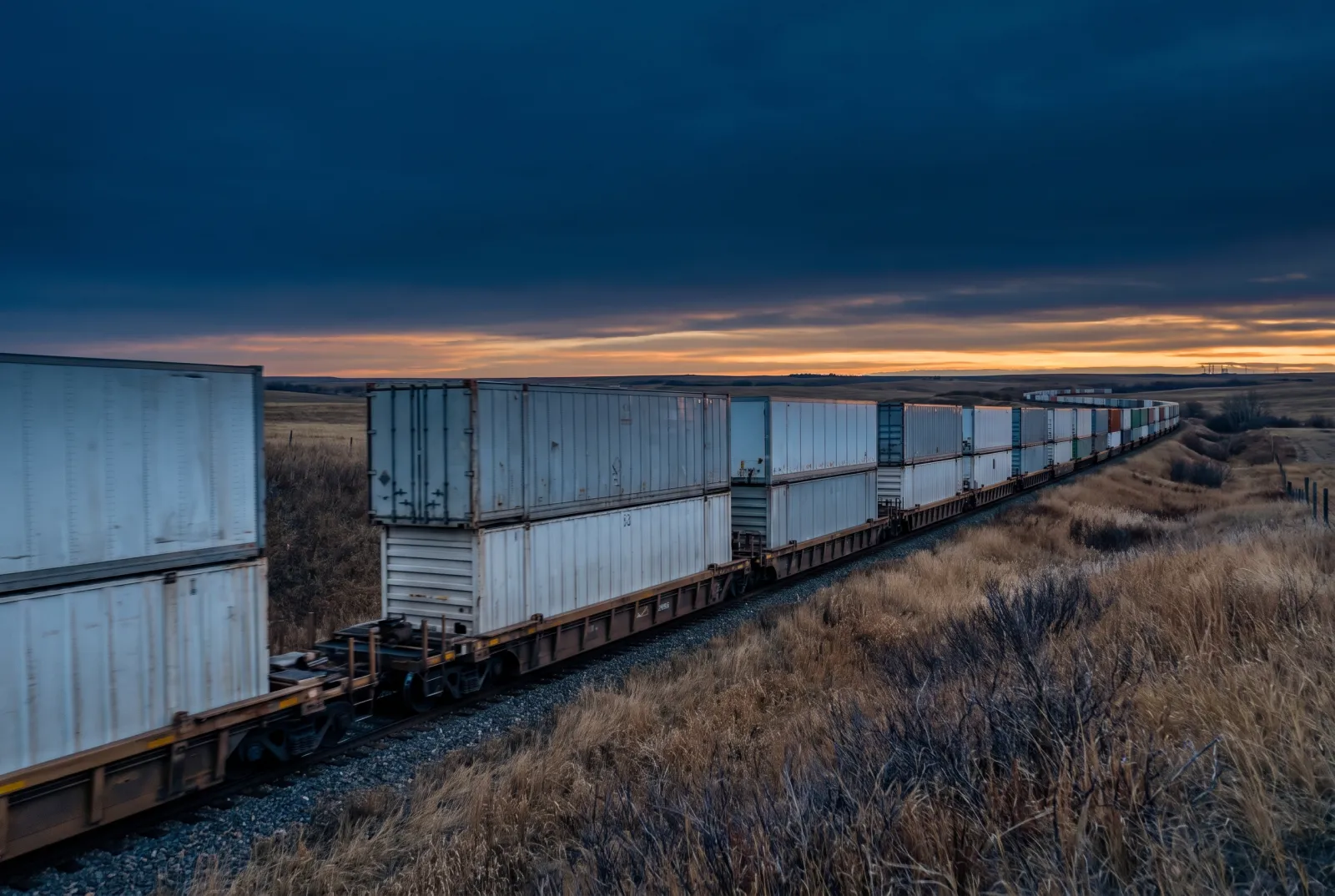
Rail and Intermodal Freight in Canada, the U.S. and Across the Border
How rail freight works across North America: the Canadian and U.S. networks, cross-border rail into the United States and Mexico, drayage and container weight, and how to choose between road and rail one shipment at a time.
Published October 5, 2026 · Updated October 6, 2026 · Stryke Logistics
1How intermodal freight works
Intermodal freight moves in a container or trailer that travels the long leg by rail and the short legs at each end by truck. The truck legs are called drayage. The shipper loads a container at its own dock, a dray carrier takes it to the rail ramp, the railway moves it to the ramp nearest the consignee, and a second dray delivers it. The freight itself is not handled between the two docks.
Two kinds of container dominate. Domestic intermodal in Canada and the United States runs mostly in 53-foot containers, the same length as a highway van, so a shipper can switch a lane between road and rail without changing how it loads. International freight moves in 20- and 40-foot ocean containers that arrive at ports and are railed inland. Some lanes still move highway trailers on flatcars, but most domestic volume is now containerised and stacked two high.
Most shippers buy intermodal through an intermodal marketing company or a transportation provider rather than directly from a railway. The provider books the rail, arranges both drays, sources the container and manages the paperwork, so the shipper deals with one party and one rate from door to door.
Typical 53-foot container payload
About 42,500 to 43,500 lb
Typical 53-foot dry van payload
About 45,000 lb
Rail manifest into Canada
At least 2 hours before arrival (ACI eManifest)
Rail manifest into the U.S.
At least 2 hours before arrival (ACE)
Where rail usually starts to pay
Beyond about 400 miles (650 km), more clearly on longer lanes
Intermodal saving versus truckload
Typically 16 to 25 percent; about 30 to 34 percent in Q2 2026
2Rail in Canada: two transcontinental networks
Canada has two Class I railways, and both run from coast to coast. CN operates roughly 30,000 kilometres of track and is the only North American railway that reaches the Atlantic, the Pacific and the Gulf of Mexico. CPKC, formed when Canadian Pacific and Kansas City Southern combined in 2023, runs from Vancouver and Montreal through the U.S. Midwest to Mexico on one network.
For a shipper in the Greater Toronto Area, both are close to home. CPKC's Vaughan Intermodal Terminal sits on Highway 50 between Rutherford Road and Major Mackenzie Drive, on about 770 acres. CN's main intermodal terminal for the region is in Brampton, with further facilities at Malport and Mississauga. Both railways serve Montreal, Winnipeg, Calgary, Edmonton and Vancouver, and CN also serves Halifax, Moncton, Regina, Saskatoon, Prince George and Prince Rupert.
Typical domestic lanes
Lane
Typical intermodal transit
Notes
Toronto to Montreal
Rarely competitive
About 540 km; truck usually wins on both cost and time
Toronto to Winnipeg
About 2 to 3 days ramp to ramp
A common rail lane, and a useful alternative to winter driving
Toronto to Calgary or Edmonton
About 3 to 4 days ramp to ramp
Core rail lanes for consumer goods and food
Toronto to Vancouver
About 4 to 6 days ramp to ramp
Rail is the default for planned, non-urgent volume
Halifax to Toronto, port trains
About 35 hours
CN service for ocean containers from the Port of Halifax
Transit times are ramp to ramp and vary by railway, train and season. Add time at each end for drayage, and check the current schedule for the specific lane before committing to a delivery date.
Temperature-controlled rail
Both railways move refrigerated containers. CPKC added 1,000 refrigerated 53-foot containers to its fleet in 2023, more than doubling it, largely for its Canada, U.S. and Mexico service, and CN runs refrigerated and insulated container service on its domestic network. Refrigerated intermodal works best for frozen and temperature-stable product on predictable schedules. Fresh produce with a short life usually stays on the road.
3Rail in the United States
Six Class I railways operate in the United States. BNSF and Union Pacific dominate the West, CSX and Norfolk Southern the East, and CN and CPKC run their own U.S. lines: CN down the middle of the continent to the Gulf of Mexico, CPKC from the upper Midwest through Kansas City to Texas and Mexico. Chicago is where most of these networks meet, and freight crossing the country usually changes railways there.
That interchange is the difference between single-line and interline service. A single-line move stays on one railway from origin ramp to destination ramp. An interline move is handed from one railway to another, usually in Chicago, which adds time and one more place where things can go wrong. Shared container pools narrow the gap by letting one container run across partner railways: EMP is shared by Union Pacific and Norfolk Southern, with CN as a participating railway, and UMAX by Union Pacific and CSX, each with more than 40,000 53-foot containers.
The fastest U.S. intermodal lanes compete directly with trucks. Union Pacific runs a premium three-day service between Los Angeles and Chicago, and interline services between Southern California and Ohio run in about four to five days.
The map may change. Union Pacific and Norfolk Southern agreed to merge in 2025, and the Surface Transportation Board moved the case to its merits review in August 2026, with final briefs due in May 2027. Until a decision, they remain separate railways and interline service between them works as it does today.
4Cross-border rail: Canada, the U.S. and Mexico
Rail crosses the Canada and U.S. border at a handful of points, and which one a shipment uses depends on the railway. Rail freight does not stop at the border the way a truck does: the railway transmits cargo data electronically before the train arrives, customs makes its release decision in advance, and only shipments selected for examination are set aside.
Crossing
Railway
What to know
Sarnia, ON to Port Huron, MI
CN
The Paul M. Tellier Tunnel takes double-stacked containers; CN's main route between Ontario and Chicago
Windsor, ON to Detroit, MI
CPKC
The busiest Canada and U.S. rail crossing by trade value; the Detroit River tunnel cannot take double-stacked cars, which limits container capacity
Fort Erie, ON to Buffalo, NY
CN, also used by CPKC
The International Railway Bridge, for the U.S. Northeast
Fort Frances, ON to Ranier, MN
CN
The U.S. and Canada crossing with the most railcars, according to CBP
Emerson, MB to Noyes, MN
CPKC and BNSF
Prairie gateway to the U.S. Midwest
North Portal, SK to Portal, ND
CPKC
Western Canada to the U.S. Midwest
Nuevo Laredo to Laredo, TX
CPKC
The main U.S. and Mexico rail gateway; a second bridge span completed in December 2024 more than doubled capacity
Piedras Negras to Eagle Pass, TX
Union Pacific and Ferromex
Used by the CN, Union Pacific and Ferromex interline service between Canada and Mexico
Customs on a rail shipment
Into Canada, the rail carrier or its service provider transmits cargo and conveyance data through ACI eManifest, and CBSA must receive it at least two hours before the train arrives at the first port of arrival.
Into the United States, CBP requires electronic rail cargo data at least two hours before arrival, filed by the railway or by an approved broker or forwarder.
The importer's customs broker files the entry in advance, exactly as for a truck, and the railway's manifest and the broker's entry have to match.
Freight crossing the United States between two points in Canada, or between Canada and Mexico, moves in bond and still needs a manifest.
From October 26, 2027, rail exports from the United States will also need an electronic export manifest in ACE, with initial data 24 hours before departure and the rest two hours before, under a CBP rule finalised in August 2026.
Canada to Mexico by rail
Since 2023 there has been a single-railway route from Canada to Mexico. CPKC's Mexico Midwest Express runs daily from Chicago and Kansas City to Laredo on the third day, Monterrey on the fourth and San Luis Potosi in about four and a half days, connecting to its Canadian network. CN, Union Pacific and Ferromex run a competing interline service between Toronto or Detroit and Monterrey or Silao through Eagle Pass. For steady volume between Ontario and central Mexico, either can beat a road move that crosses two borders and changes trucks at the Rio Grande.
5Drayage, terminals and the clock
Most intermodal problems happen in the first and last few kilometres, not on the train. Drayage is the truck move between a rail terminal and the shipper or consignee, usually under 50 miles, and it runs on the terminal's clock. Missing that clock costs money.
Cut-off: the latest time a loaded container can be in-gated to make a particular train. Miss it and the container waits for the next departure, which on some lanes is the next day.
Free time: how long a container can sit at the destination terminal after it comes off the train before storage charges start. It is measured in hours or a few days and has been tightening; CN cut free time at Montreal from 48 to 24 hours in 2022.
Per diem: what the container's owner charges for each day the container is out of the terminal beyond the agreed time, including while it sits at your dock waiting to be loaded or unloaded.
Chassis: the wheeled frame the container rides on during drayage. A shortage of chassis, or a defective one, delays pickups more often than the railway does.
The practical rule is that loading and unloading appointments are planned around the train, not the other way round. A dock that can turn a container the day it arrives keeps intermodal cheap; one that holds containers for days turns the saving into storage and per diem.
6Weight, loading and securement
Rail does not let you load heavier. A 53-foot domestic container typically takes about 42,500 to 43,500 pounds of cargo, against roughly 45,000 pounds in a 53-foot dry van. The container and chassis weigh more than a van trailer, and the drayage legs still have to meet highway weight limits at each end.
Dense freight that reaches the weight limit in a van will reach it sooner in a container. Light, bulky freight that fills a trailer by volume before weight is where intermodal is most comfortable.
Freight on rail also rides differently. Trains are assembled and broken up in yards, and railcars take shocks along their length as they couple and as slack runs in and out of a long train. Freight that travels safely in a van can shift in a container. Block and brace loads against forward and backward movement, fill voids, keep heavy items on the floor and follow the loading guidance published for intermodal equipment.
7Road or rail: choosing per shipment, not per year
On most long North American lanes, road and intermodal are both viable, and the right answer changes. Rail pricing moves with contracts and terminal capacity; truck pricing moves with the season, fuel, weather and produce volumes. A lane that is clearly a rail lane in February can be a truck lane in July, and a shipper locked into one mode pays for it.
The gap can be wide. In the second quarter of 2026, intermodal ran about 34 percent below spot truckload rates and about 30 percent below contract rates, according to one industry index, against a more typical 16 to 25 percent, largely because high diesel prices push truck rates up faster than rail. It can also close: there have been periods when trucks were cheaper than rail on lanes such as Los Angeles to Dallas.
We treat mode as a per-shipment decision. Our transportation management system rates road and intermodal side by side for every eligible lane, on the three things that matter: rate, transit time and service. Service means the terminal cut-off, the reliability of the carrier on that lane and whether the delivery window can actually be hit. When rail is cheaper and the window allows it, the load goes rail. When capacity tightens or the customer needs it Tuesday, it goes road. Then it goes back.
Road
Intermodal rail
Transit
Fastest door to door
Slower; allow time for drayage at each end
Cost on long lanes
Higher
Typically 15 to 30 percent lower
Flexibility
Pickup and delivery around your schedule
Planned around train cut-offs and terminal hours
Payload
About 45,000 lb in a 53-foot van
About 42,500 to 43,500 lb in a 53-foot container
Best for
Short lanes, fixed appointments, fresh product, high-value freight
Long lanes, planned weekly volume, dry and frozen product
Carbon
Higher
Substantially lower per tonne-kilometre
Rail usually wins on lanes over about 1,500 kilometres with a delivery window of a few days, on dry and frozen product, and on repeatable weekly volume.
Road usually wins on anything under two days' transit, on produce and fresh product, on high-value loads, and whenever the delivery appointment is fixed.
The wrong answer is picking one and never revisiting it. The market changes, and the lane should be re-rated every time it is tendered.
8Rail and carbon
For shippers with emissions targets, mode is the largest single lever in the freight budget. The Railway Association of Canada reports that rail moves a tonne of freight more than 220 kilometres on a litre of fuel and is three to four times more fuel-efficient than trucking, while producing about 3 percent of Canada's transportation greenhouse gas emissions. In the United States, the Association of American Railroads puts rail at nearly 500 ton-miles per gallon, and industry estimates put the saving from moving freight from truck to rail at up to 75 percent.
Those are network averages. The saving on a particular shipment depends on the length of the drays and how full the container is, so a lane-level estimate is more useful than a headline figure for emissions reporting.
9What can disrupt rail, and how to plan for it
Rail is reliable in the ordinary course and exposed to a few large risks that trucking spreads out. Canada's two railways carry most of the country's intercity freight, so a disruption at one of them is felt across whole lanes at once.
Labour: in August 2024, CN and CPKC locked out about 9,300 running-trades employees at the same time, stopping most Canadian rail freight until the federal government intervened and the labour board ordered a return to work, and recovery took several days for each day lost. CN's current agreement with the Teamsters Canada Rail Conference expires on December 31, 2026, and CPKC's at the end of 2027. A 2026 strike by CPKC's signals and communications workers ended in arbitration without stopping trains.
Ports: the 13-day strike at the ports of Vancouver and Prince Rupert in July 2023 nearly halted container rail out of British Columbia, and the backlog took weeks to clear.
Winter: below about minus 25 degrees Celsius, railways run shorter trains to keep air brakes working, which reduces capacity on the prairie and northern corridors through the coldest weeks.
Weather and wildfire: in July 2026, wildfire disrupted CN's line between Sioux Lookout and Armstrong in northern Ontario while CPKC's route kept running.
Trade: tariffs between Canada and the United States have reduced cross-border rail volumes since 2025, which can change service and pricing on cross-border lanes.
The answer to most of these is the same as the answer to rate: keep the option to switch. A lane that can move by road or by either railway, coordinated by the same provider, can be moved off a disrupted network quickly instead of waiting for it to recover.
Questions shippers ask
Is intermodal cheaper than truckload?
Usually, on long lanes. Intermodal has typically run 16 to 25 percent below truckload, and in mid-2026 the gap was wider, around 30 percent or more, because of high diesel prices. On short lanes, generally under about 400 miles, truck is usually cheaper once both drayage legs are counted. The only reliable answer is to price both on the specific lane at the time of shipment.
How much longer does intermodal take than a truck?
Usually one to three days longer door to door. Toronto to Vancouver is about four to six days ramp to ramp by rail, plus drayage at each end, against about five to six days for a solo truck or about three for a team. That is why rail suits planned freight rather than urgent loads.
Which railways serve the Greater Toronto Area?
Both Canadian Class I railways. CPKC's Vaughan Intermodal Terminal is on Highway 50 in Vaughan, and CN's main intermodal terminal for the region is in Brampton, with further facilities at Malport and Mississauga.
Can intermodal handle refrigerated freight?
Yes. Both CN and CPKC operate refrigerated 53-foot containers, and CPKC more than doubled its refrigerated fleet in 2023. Refrigerated rail suits frozen and temperature-stable product on predictable schedules; fresh produce with a short shelf life usually moves by road.
How does rail freight clear customs at the border?
The same way a truck does, electronically and in advance. The railway transmits its manifest at least two hours before arrival, into Canada through ACI and into the United States through ACE, and the importer's customs broker files the entry ahead of the train. When the two match, the release is decided before the train reaches the border.
How much can I load in a 53-foot intermodal container?
About 42,500 to 43,500 pounds of cargo, slightly less than a 53-foot dry van, because the container and chassis weigh more and the drayage legs must meet highway weight limits. Light, bulky freight suits intermodal best.
What is drayage?
Drayage is the short truck move between a rail terminal or port and the shipper or consignee. On an intermodal shipment there is a dray at each end, and they run on the terminal's clock: cut-offs for making a train, and free time before storage and per diem charges start.
HS chapters for this freight
Every six-digit code in each chapter, with the official government descriptions.
Send us the lane, the volume and the delivery window and we will price it by road and by rail, side by side. You can also estimate it yourself with our truck and rail transit calculator.